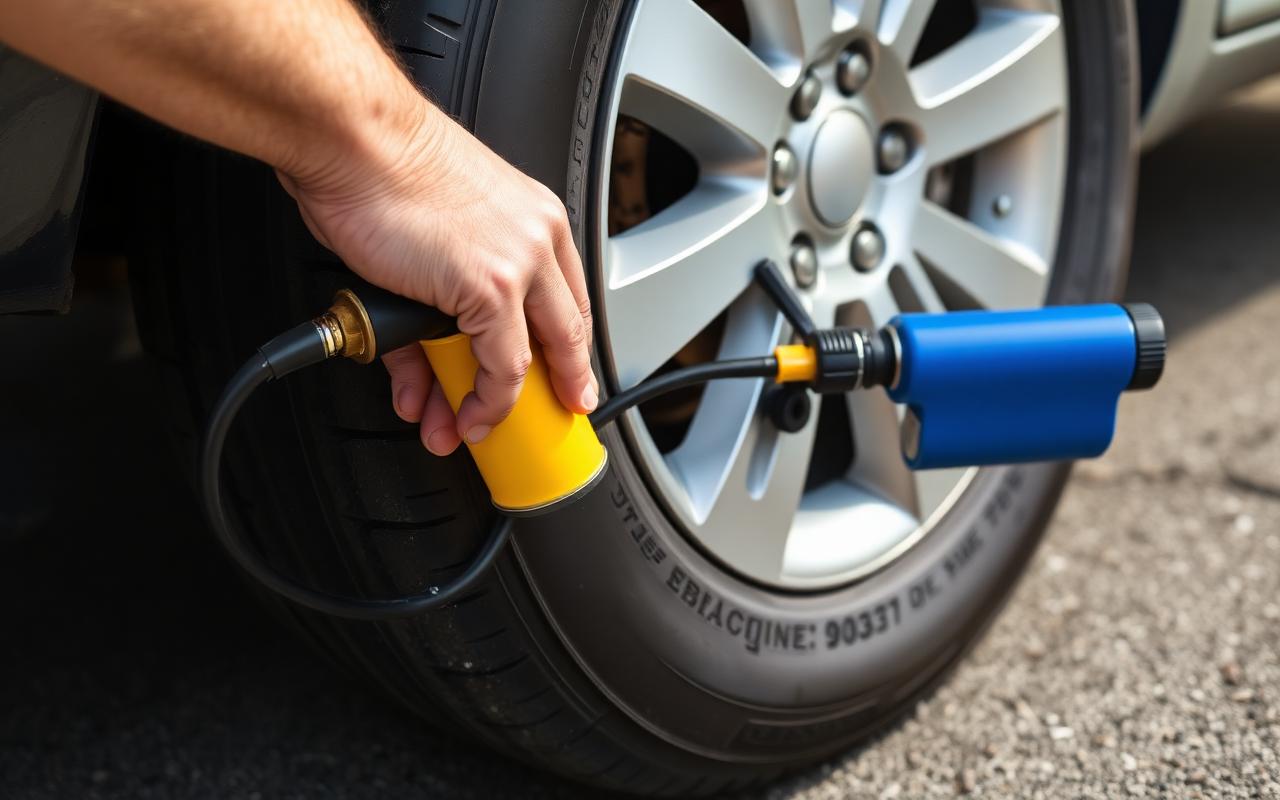
What's in a puncture repair kit
- A bottle of liquid sealant (usually 300–500ml of latex-based foam).
- A 12V compressor that plugs into the cigarette lighter.
- A connecting hose.
- Spare valve cores (some kits).
- Speed-limit stickers (often missed — meant to be applied to the dashboard as a reminder).
When the kit works
Tyre-mobility kits are designed for a narrow set of punctures:
- Small holes (up to about 4mm) caused by sharp objects.
- Damage in the central tread area only.
- The tyre is still mostly on the rim (not run completely flat).
- The puncturing object can be left in place or removed cleanly.
Step-by-step usage
- 1Stop on level ground. Hazards on. Get passengers out.
- 2Remove any visible debris from the puncture if it pulls out easily — don't dig.
- 3Shake the sealant bottle vigorously for 30 seconds.
- 4Screw the bottle to the kit's hose (or attach via the kit's valve, depending on design).
- 5Unscrew the tyre's valve cap. Some kits require you to remove the valve core entirely — check your kit's instructions.
- 6Connect the hose to the tyre valve.
- 7Plug the compressor into the 12V socket and turn the car's ignition to accessory mode.
- 8Switch on the compressor. It will pump sealant into the tyre, then inflate to pressure (5–10 minutes total).
- 9Stop when the gauge reaches the recommended PSI (usually 32–36 — check the door sticker).
- 10Disconnect, replace the valve cap and DRIVE IMMEDIATELY — slowly for the first mile to spread sealant.
Three scenarios where the kit will fail
1. Sidewall damage
Sealant can't bridge a sidewall tear — the tyre flexes too much. The kit will inflate, you'll drive 200 metres, and the sealant will spray out. Same applies to shoulder damage.
2. Holes larger than 4mm
Big nails, screws or glass shards leave holes the sealant simply can't seal. You'll see foam bubbling out of the tyre as it inflates.
3. Tyre off the rim
If you've driven flat and the tyre has popped off the rim's bead, sealant won't re-seat it. You need a fitter with a proper bead-seating tool.
What sealant does to your tyre
Latex sealant coats the inside of the tyre. Once dried, it's hard to remove fully and many fitters will charge a £10–£15 cleaning surcharge before they can carry out a permanent BS-compliant repair. Some sealants also damage TPMS sensors — the sensor's electrical contacts can corrode after sealant exposure, leading to a £35–£90 replacement.
When you should call a mobile fitter instead
Don't waste time on the kit if:
- You're on a red route, motorway or any unsafe location.
- You can see the damage is in the sidewall.
- You can see a hole or tear larger than 4mm.
- You've already driven on the flat for more than a few hundred metres.
- You're not confident with the kit — most people only do this once in a lifetime.
Need a tyre fixed right now?
Mobile fitter to your London location in under 35 minutes.